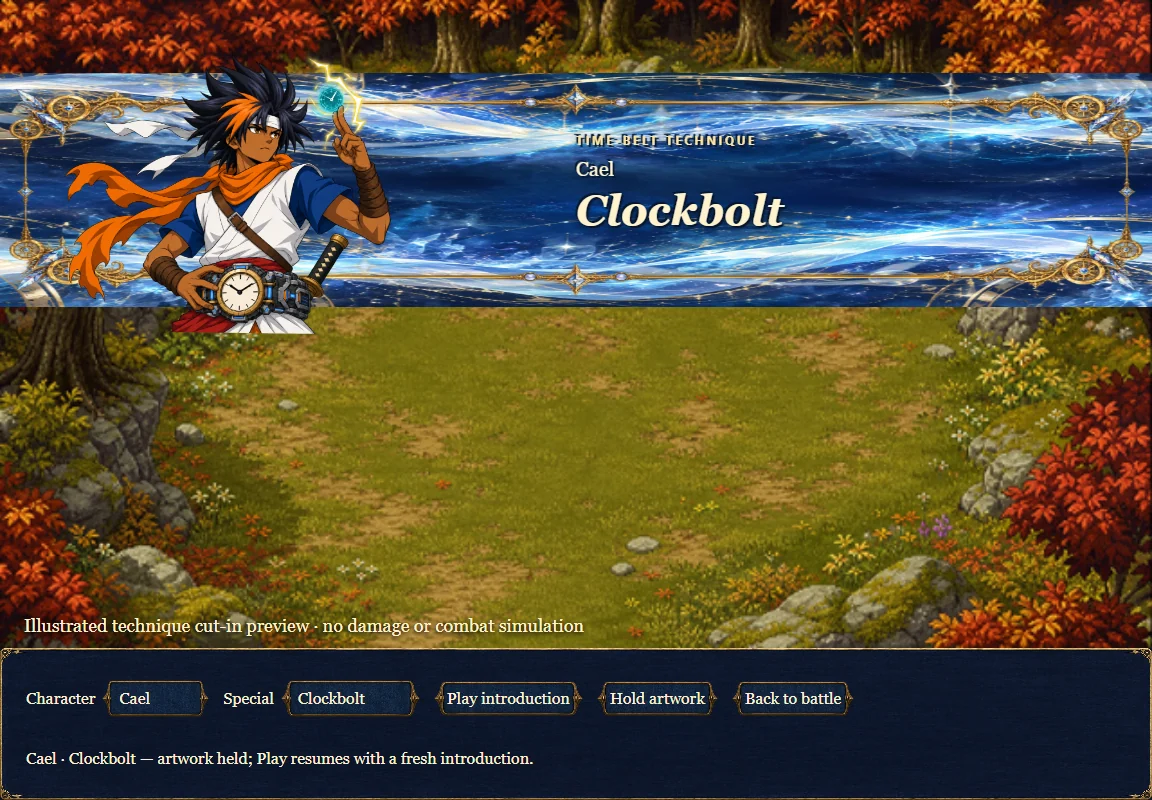
The current battle prototype starts with a simple visual question: where does an action come from? In The Alcohol of Time, a character’s clock belt gives magic a recognizable origin. The effect should belong to that character and that technique, rather than appearing as an unrelated flash somewhere on the screen.
That means paying attention to a drawing’s belt and hand positions. An authored casting pose can use a wider canvas than a standing sprite, yet the character should not suddenly shrink or slide off the floor. Placement follows the current drawing so the belt, palm, projectile, and target remain connected as the pose changes.
Different techniques, different readings
The prototype’s catalog already separates elemental attacks and support actions. Cael has storm and time techniques; Katia combines archery with healing and restorative support; Tessa brings ember flasks, bombs, and engineered effects. Projectile, area, target, and support presentations have different jobs. A bow shot needs a clear release and destination. An area effect needs to read across the formation. A healing effect needs to make its recipient legible.
Active Time Battle provides the rhythm around those actions. Gauges, available commands, and party combinations create decisions; the visual sequence explains the decision that was actually made. Single, Dual, and Triple Techs are part of the current prototype. Their presence is not a claim that every part of the full game is finished.
Let the introduction finish
Special attacks now have technique-specific illustrations over a detailed, scrolling painted backdrop. The introduction plays before the action begins. That ordering matters: if the character moves or the attack lands while the banner covers the field, the player can miss the very action the introduction is meant to announce.
An introduction should create anticipation, then give the battlefield back.
The aim is not to turn every command into a longer interruption. It is to make the existing moments readable: gather, release, contact, recovery. Costs, recipients, status outcomes, and damage still belong to the battle rules. A dramatic picture does not quietly add another attack or change a probability.
This is ongoing presentation work in a development build. The promo offers an edited glimpse of it; the early battle demo gives a more direct look at the prototype. Neither is a finished story-game release. Next, we’ll look at the other half of readability: creatures that move and fall as their own drawn bodies.