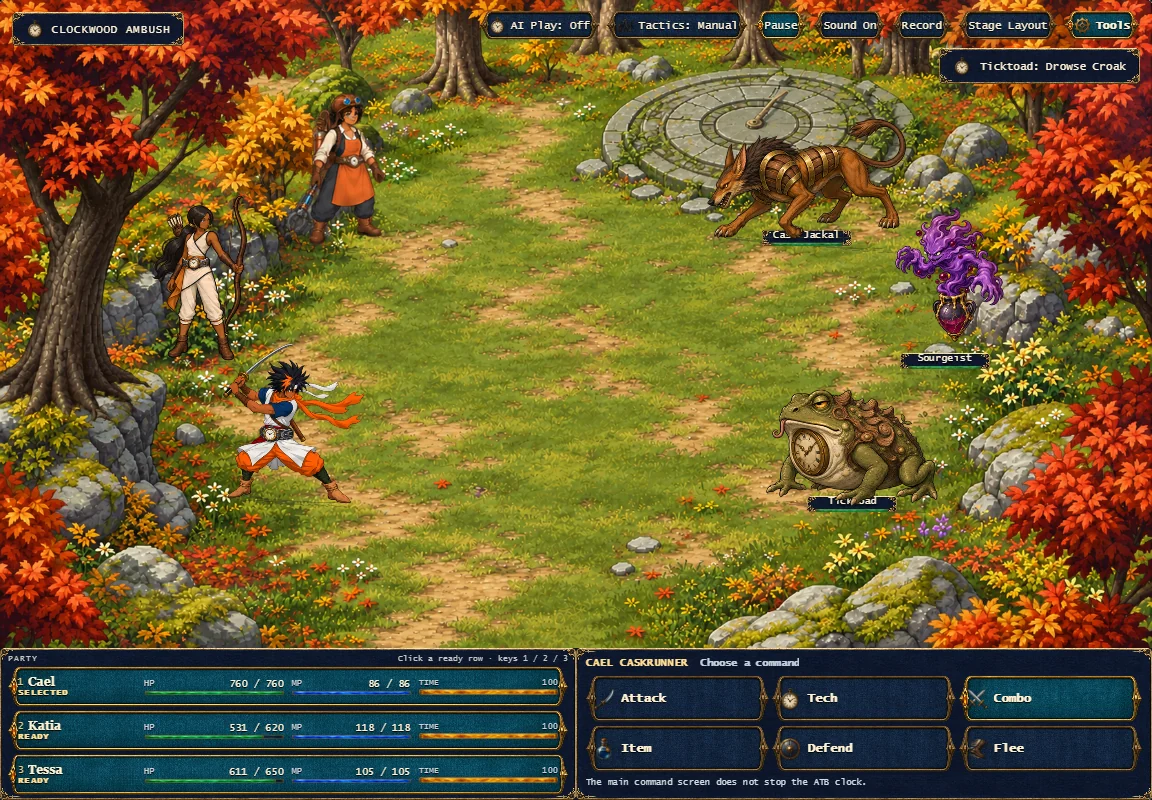
As of October 13, the authoritative animation record lists 99 of 174 monster entries as live-verified and admitted to the runtime. That leaves 75 unfinished. This is useful progress, but it is not a statement that the game is complete, or that every drawing waiting in staging has already passed a battle test.
The distinction matters because a source sheet is only one part of an animation. A creature can have attractive drawings and still need placement, scale, transparent-padding, lighting, and combat review. A staged kit stays staged until those pieces work together in the actual battle presentation.
What belongs in a kit?
The full drawn-kit standard is 28 cels: six idle frames, six frames of the creature’s own locomotion, three distinct four-frame attack presentations, and four collapse or defeat frames. The last frame is an opaque down pose. A defeated monster should have a visible material ending—not simply turn transparent and disappear.
Locomotion also has to belong to the creature. Legs, joints, roots, wings, or a limbless body need to articulate rather than borrowing another monster’s movement. Translating an unchanged standing picture across the screen can move an object, but it does not create a gait. Likewise, a scaled or rocked image is not a substitute for drawn poses.
Approach, contact, return
Grounded physical attackers use their own approach motion, hit, and visibly jump back to their starting place. Flying and floating creatures use appropriate movement exceptions. Some spellcasters stay planted during their combat actions; their locomotion can still be reviewed separately without inventing a melee charge for them.
A cosmetic presentation is not a new combat decision.
Several distinct-looking presentations can sit over an existing decision pool. The drawing work does not silently introduce extra damage, healing, probabilities, or random-number calls. Keeping that boundary clear lets us improve what the player sees without rewriting the enemy’s behavior at the same time.
The review also follows the creature through an entire sequence: healthy idle, approach where appropriate, the actual attack, return, collapse, held down pose, and restart. Drawings need consistent body scale and enough canvas room to keep limbs and effects readable. Current-pose lighting and shadows must follow the image that is actually being shown.
The next work continues with unfinished kits already in progress. The goal is a complete roster, but a target is not a completion credit. We’ll keep reporting the verified count separately from the art that is still being drawn, assembled, or checked.